
How change management makes policy shifts and legal compliance stick

At most companies, the words “policy update” trigger a collective groan. New data privacy protocols, updated internal policies and compliance requirements usually feel like a bureaucratic headache.
But the best organizations know it doesn’t have to be that way. When people understand what’s changing, why it matters and how it affects their day-to-day work, employee adoption follows. That’s where change management comes in — and why it’s essential for making policy shifts and legal compliance actually doable.
What’s change management anyway?
Change management is the structured approach to moving individuals, teams and organizations to a new way of working. Yes, it’s about rolling out new processes, but it’s also about helping people understand, adopt and embrace change so policies actually stick.
Why it matters: 70% of change initiatives fail, usually because a lack of planning or support leads to employee resistance (understandably so). But strong change management creates measurable adoption, reduces risk and builds trust across teams.
Policy is the “what.” Change management is the “how.”
Legal and regulatory requirements define the "what" — the rules a company has to follow to stay compliant. Policies translate those rules internally.
But humans are creatures of habit. Simply announcing a policy doesn’t change their behavior. Change management provides the "how" — the roadmap for moving people from the old way of working to the new, compliant way.
For example:
What: A new data privacy policy requires employees to follow stricter rules for handling customer information.
How: Employees are briefed on the change, trained on how to handle data in the approved systems, given time and support to adjust their workflows and reminded through system prompts and manager check-ins.
Change management mitigates legal risk.
Having a new policy doesn’t mean much if no one actually follows it (which can be especially problematic if it’s a legal requirement). Change management closes that gap by addressing the full arc of adoption:
Awareness: Employees understand what’s changing and why it matters. Example: informing people about a new remote-work data security protocol.
Desire: People see the value in complying, not just the obligation. Example: recognizing that updated expense reporting rules make their own approvals faster.
Knowledge: Employees know what to do differently to meet the requirement. Example: learning how to handle personally identifiable information under a new GDPR guideline.
Ability: Teams can apply the policy correctly in their day-to-day work. Example: using a new health and safety checklist during on-site inspections.
Reinforcement: Systems and follow-through make the change stick, creating the kind of paper trail legal teams love. Example: implementing automated reminders and manager check-ins for quarterly compliance updates.
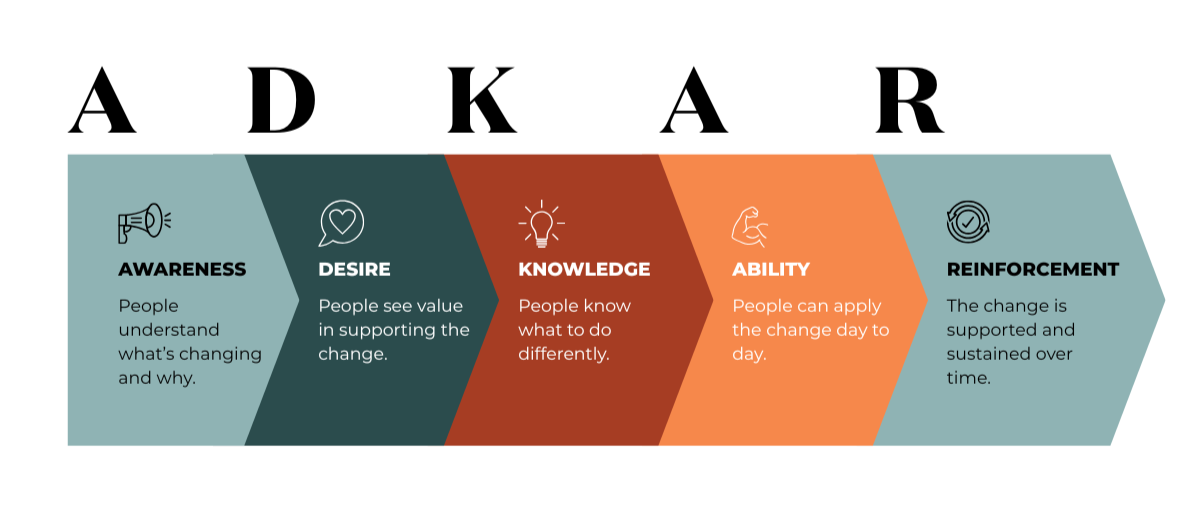
ADKAR is a practical framework for understanding how people move through change. But think of it as guidance, not a guaranteed recipe. Every team has its own circumstances.
Compliance sticks when communication flows.
Policies and legal requirements don’t work on their own. The teams defining the rules need to collaborate closely with those helping employees adopt them. When these groups collaborate, policies are not only accurate — they’re understandable, usable and more likely to be followed.
Here’s how that partnership plays out at each stage of the change:
| Phase | Legal / policy role | Change management role |
|---|---|---|
| Design | Define mandatory constraints and risks | Assess the impact on daily workflow |
| Communication | Ensure language is accurate and defensible | Translate “legalese” into actionable guidance |
| Implementation | Monitor breaches | Identify resistance points and support adoption |
Tip: Avoid corporate clichés in your communications. Although they might seem like “proper” workplace verbiage, they won’t engage your team.
Change management prevents resistance.
Legal changes are non-negotiable. Think new data security requirements, updated workplace safety rules or stricter guidelines around handling customer information. That “forced” nature can trigger pushback, not because employees want to break the rules, but because they don’t fully understand what’s changing or how it affects their day-to-day work.
Effective change management addresses this through education and psychological safety: providing clear guidance, explaining the reasoning behind the change and giving people the support and space to adapt. When employees know what to do, why it matters and that questions or mistakes won’t get them in trouble, they’re more likely to be on board.
Tip: Check out 8 common reasons employees resist change, so you can prevent them instead of react to them.
Policy is much more than paperwork.
Legal and policy updates are coming faster than ever. Treat them as “just paperwork,” and you risk turnover, low morale and liability. Integrate change management, and you don’t just move forward — you evolve.
Simple takeaways for leaders:
Focus on adoption, not just the rules.
Communicate clearly and frequently.
Anticipate resistance and provide guidance.
Use change frameworks like ADKAR as guides, not checklists.
Avoid common pitfalls in the change management process.
